
We may earn money or products from the companies mentioned in this post.
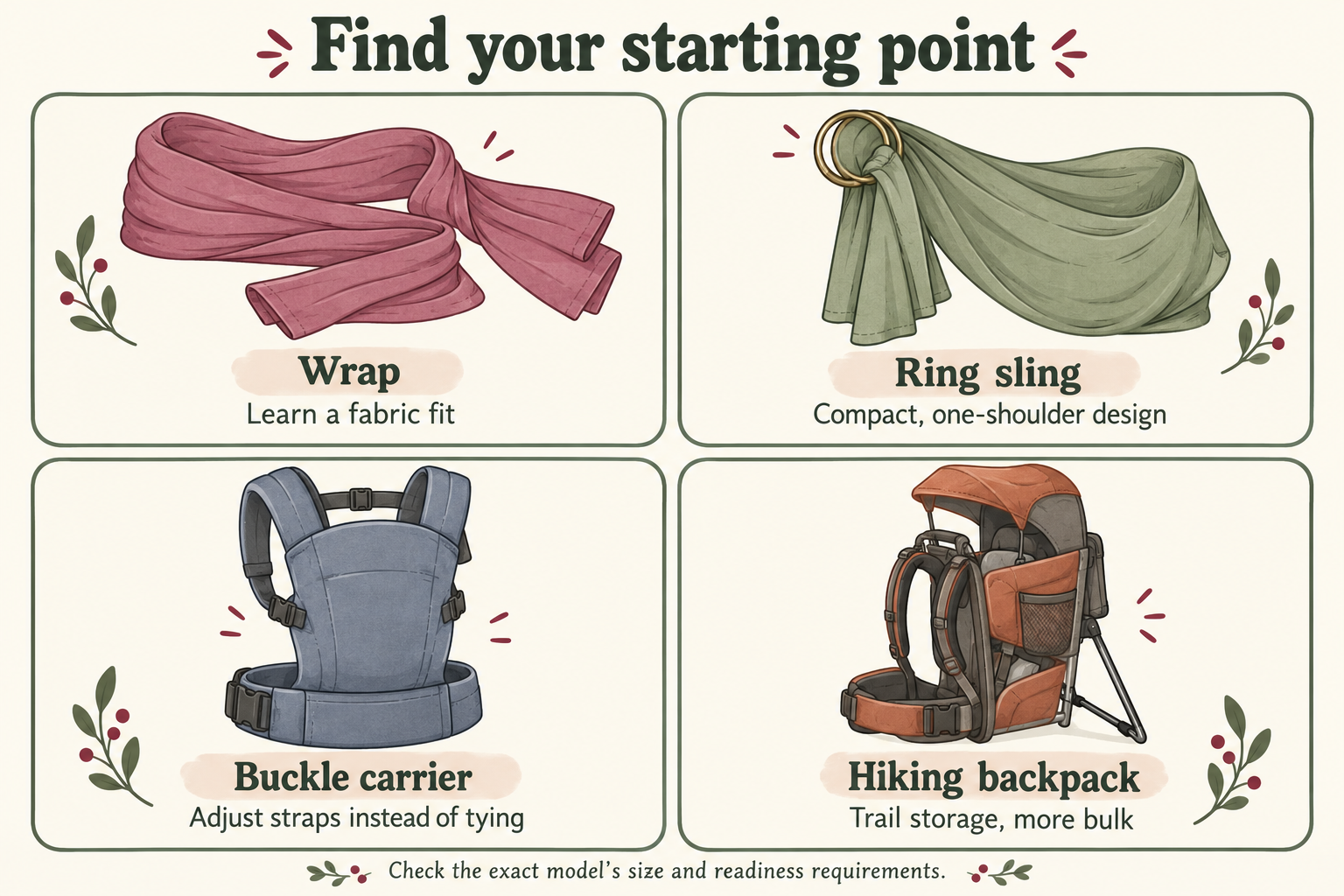
Start with how you want to carry, then choose a product. A wrap gives you a fabric fit to learn and adjust. A ring sling is compact but loads one shoulder. A buckle carrier replaces tying with straps and fastenings. A framed hiking backpack adds a child seat and storage, along with considerable bulk.
Our quick take: For repeat errands and shared use, start by trying a buckle carrier. For a close, fabric-only fit, compare stretchy and woven wraps. For frequent short carries, consider a ring sling. For trail days with a child who meets the specific readiness requirements, look at a framed backpack. None is the right choice for every family.
This review draws on manufacturer specifications and instructions, rather than hands-on testing.
The main differences at a glance
| Type | Why consider it? | Main compromise |
|---|---|---|
| Stretchy wrap | Soft fabric without buckles; adjustable wrapping fit | Long fabric and correct tension take practice; permitted carries are limited |
| Woven wrap | Many lengths and carry options to learn | Choosing a length and learning each carry require attention |
| Ring sling | Compact design for taking along and short carries | One-shoulder loading; threading and tightening still need practice |
| Buckle carrier | Repeatable strap adjustments without tying a long wrap | Waistband and strap shape may suit one adult better than another |
| Framed hiking backpack | Child harness, pack-style suspension and gear storage | Heavy and bulky; unsuitable before the model’s readiness requirements are met |
These are starting points, not promises about comfort. A well-adjusted example of your second-choice style can be more useful than a poorly fitting example of your first.
Wraps: first choose stretchy or woven
Stretchy wraps
A stretchy wrap is a long piece of knit fabric that you tie around yourself. The appeal is the absence of a rigid waistband or buckle system. The trade-off is learning the correct tension and arranging the fabric as the instructions show. Buying something with fewer parts does not remove the need for a fit check.
Current example: Boba Classic Wrap. The Gray version is 95% cotton and 5% spandex, approximately 5.5 yards long, and rated for 7–35 lb. Boba says it works best up to 20 lb; that is a useful comfort caveat, rather than a different printed maximum. It is machine washable and dryer-friendly. See Boba’s Classic Wrap specifications or check the Boba Gray wrap listing on Amazon.
The Boba instructions specify inward-facing use. Do not assume that a position demonstrated with a woven wrap is suitable for this stretchy wrap. Start with the manufacturer’s wrap support and tutorials, and follow the instructions supplied with your exact product.
Choose this route if: you like the idea of a fabric-only carrier and are willing to practise the tying routine. If you mainly want a carrier for rapid handoffs between adults, try a buckle option alongside it before deciding.
Woven wraps
Woven wraps are a distinct category, not simply stretchy wraps made with a different pattern. Length and weave influence how you can tie them. A longer wrap may support a particular multilayer carry, while a shorter one suits other techniques. Match the length to your body and the carries you intend to learn.
Current example: DIDYMOS Baby Wrap Sling Leo. The manufacturer lists this jacquard wrap in 100% organic cotton at 240 g/m², with sizes 2–8 selectable. The fabric weight is a textile specification, not a child-weight rating. The product page does not give a numerical child-weight range, so we do not substitute a retailer’s generic limit. See the Leo wrap details.
DIDYMOS provides carry-specific tutorials. Begin with an appropriate upright front carry and seek qualified fitting help before moving to unfamiliar techniques. Do not use another carrier’s age threshold as permission to try a back or hip carry.
Choose this route if: learning to wrap is part of the appeal, rather than a task you want to avoid. If buying without a try-on, get advice about length before selecting a color.
Ring slings: compact, with a different learning curve
A ring sling passes fabric through two rings to adjust the fit. There is no long wrapping sequence, but you still need to thread it correctly, form a secure seat and tighten different sections of fabric. “Quick to use” describes a learned routine, not necessarily your first attempt.
Because the fabric sits over one shoulder, pay attention to how that arrangement feels for you. We would try it before choosing it as your sole carrier for long outings. Its compactness can be appealing when you want something to take along for shorter carries.
Current example: hope&plum Palm Ring Sling. The brand lists a 55% hemp/45% cotton fabric, aluminum rings and 74-, 84- and 94-inch lengths, with a 7–35 lb range. Choose length using the brand’s guide rather than assuming the longest option provides more support. Colors and lengths may sell out. See the Palm Ring Sling specifications and length guide.
Choose this route if: compact storage and short carries matter, and one-shoulder loading suits you. Use the manufacturer’s instructions and fit service if the seat slips, fabric bunches or the rings end up in an awkward position.
Buckle carriers: an everyday starting point
Soft-structured carriers use a fabric panel, shoulder straps and usually a waistbelt. Once adjusted, they offer a repeatable setup without tying a long length of fabric. The name covers many designs: a heavily padded all-position carrier and a minimal inward-facing carrier can feel quite different.
Compare the controls as carefully as the feature list. Can every wearer reach the fastening? Does the waistbelt sit comfortably? Do the straps tighten enough without pressing on the neck? If two adults share it, check how easily the settings can be changed back.
Current example: Ergobaby Omni Deluxe. This is a four-position option with an adjustable seat, padded crossable straps and lumbar support. It does not need a separate infant insert, but each mode has minimum size and development requirements. Its broad headline weight range should not be read as permission to use every position from birth. Ergobaby’s model comparison sets out the design.
Our Omni Deluxe review covers the fit checks, fabrics, position-specific limits and differences from the older Breeze.
Choose this route if: you want an everyday carrier and prefer buckle adjustments to wrapping. Do not pay for an outward-facing mode simply because it appears on a feature checklist; it is optional and may not be part of how you want to carry.
Framed hiking backpacks: for a different job
A framed child carrier combines a harnessed child seat with backpack-style suspension. Its appeal is the combination of carrying support and storage for trail outings. Its frame also makes it a much larger object to store, lift and transport than a soft carrier.
Current example: Osprey Poco. The current product page lists 24 liters of storage, a built-in sunshade and a pack weight of 7.69 lb (3.48 kg). That last number is important: you carry the pack before adding your child, water or supplies. See the current Poco specifications.
The manual linked from Osprey’s current Poco S25 page requires a child who is at least six months old, can sit upright unassisted and weighs 16–40 lb (7.3–18 kg). Separately, the maximum combined load is 48.5 lb (22 kg), including child, gear and the pack. Age alone is not enough.
For example, a 35 lb child plus the 7.69 lb pack leaves about 5.8 lb for everything else before reaching that total. That arithmetic is a packing ceiling, not a recommendation to carry a load that is uncomfortable for you.
Choose this route if: your outings justify the frame and storage, your child meets every requirement and the pack fits the adult carrying it. Try it with an appropriate load. Keep the child’s harness fastened as instructed and never leave a child unattended in the carrier, including when its kickstand is open.
Buying an older Poco? Check the label carefully. Separate recalls cover certain Poco AG models from 2016 and Poco, Poco Plus and Poco Premium models manufactured January 2012–December 2014. Follow the relevant recall notice; these older notices should not be applied indiscriminately to the current model.
Accessories: buy for a specific need
Choose the carrier first. Check what is included before buying a hood, pouch or weather cover, and use only accessories the manufacturer permits for that exact model. A matching-looking part is not proof of compatibility.
Do not use an improvised insert to make a too-large carrier fit, or add padding that changes the child’s position. Weather protection must leave the face clear and allow you to monitor your baby. Simple convenience purchases can wait until you know what you actually miss during use.
Fit basics that matter across the categories
Keep baby upright and supported, with the whole face visible, nose and mouth clear and chin away from the chest. Check breathing and temperature often. Young babies with poor head control should face inward. If baby falls asleep, move them to an appropriate crib, cradle or bassinet. Seek healthcare advice before use for premature or low-birthweight babies or babies with medical conditions. Read Health Canada’s carrier guidance.
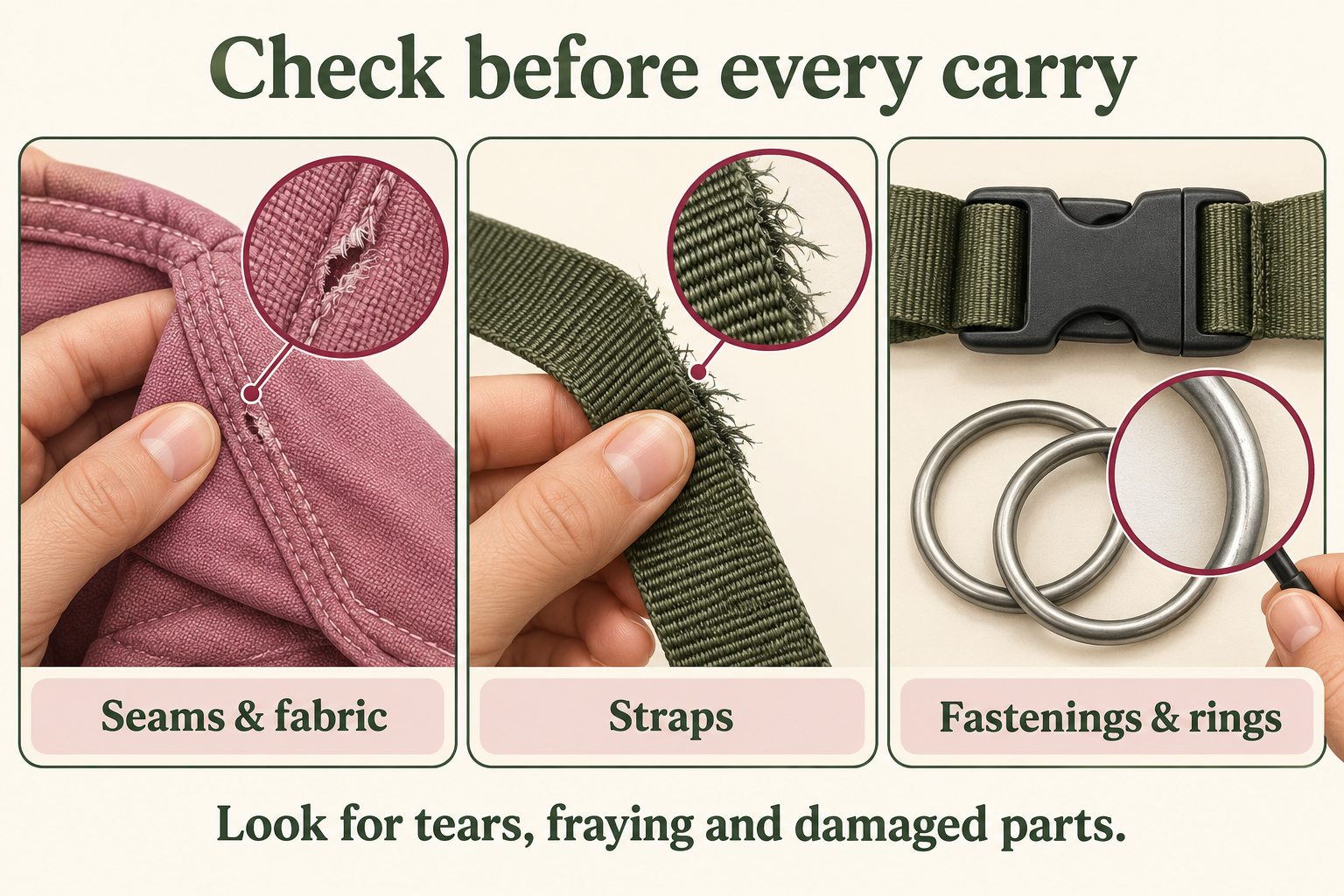
Inspect seams, straps, rings, knots and fastenings before use, and follow your model’s complete instructions. Avoid activities that introduce falls, burns or other hazards, including running, cycling and cooking. CPSC’s sling guidance also emphasizes keeping the airway clear and checking frequently.
Our October 20, 2026 check of CPSC recall data and Health Canada’s recall search did not identify a notice matching the current models listed here. That is a dated search result, not a safety certification. Check the exact label and production code against CPSC recalls and Health Canada recalls before buying or using, especially secondhand.
How to narrow the choice
- Name your main outing. Errands, short up-and-down carries and trail days do not ask the same things of a carrier.
- Check your baby’s current eligibility. Read size and development requirements for the actual model and carry, not a category-wide age chart.
- Try your two most promising styles. Include every regular wearer. A lending library, retailer fitting or manufacturer consultation can be more useful than buying extra features unseen.
- Compare the practical details. Returns, cleaning, storage and how you operate the fastenings matter after the first day.
You do not need one of everything. Start with the style that fits your most frequent use, then reconsider only if a different carrying need emerges.